
Whether The Endangerment Finding Stays Or Goes Will Be Up To The Supreme Court
Because of a feckless Congress, the Supreme Court has become the final arbiter for important policy decisions.

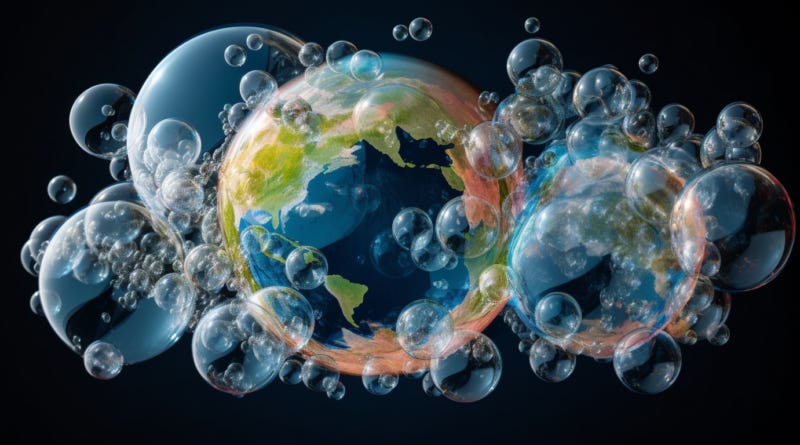
Midjourney generated image of bubbles of greenhouse gases over the earth.
This week, the US government officially eliminated the “endangerment finding” that has been embedded in federal policy since 2009. In simple terms, it says that too much carbon dioxide is a threat to the environment, which means reasonable steps may be taken to reduce how much of it gets pumped into the atmosphere by industrial operations and motor vehicles.
The basis of the pro-carbon dioxide argument is that it is essential because it is part of the process of photosynthesis that is the foundation for all plant life. Without plants, there are no animals and no food. But what the MAGA lunatics refuse to understand is that there can be too much of a good thing.
Humans need about 3 quarts of water a day. Too little or too much can have serious impacts on our health. The body also needs trace amounts of iron, zinc, copper, manganese, iodine, selenium, cobalt, molybdenum, chromium, and fluoride. But there are limits to how much of those substances the body can tolerate before dire consequences occur.
The concept of moderation is simply beyond the intellectual capability of America’s current leaders to understand. To them, we can never have enough waste products. Coal ash and nuclear waste must be allowed to accumulate with no limitations. Power plants and industrial activities must face no limits on the amount of crud they spew into the air, the soil, and the water. Commerce must not be constrained in any way. The idiocy of that policy should be intuitively obvious to the most casual observer.
Carbon Dioxide Is Not Dangerous
Grist explains the logic behind the repeal of the endangerment finding this way: “If carbon dioxide and the other greenhouse gases spewed by cars and trucks are not particularly dangerous, the logic goes, then they can’t be considered air pollutants as defined by the Clean Air Act. That means that the Environmental Protection Agency can’t regulate them, and landmark federal rules that cracked down on vehicle tailpipe exhaust and improved fuel efficiency are invalid.”
We suggest Lee Zeldin, the so-called head of the Environment Protection Agency, should spend a day inhaling the exhaust fumes of a Ford F-250. It’s possible that experience would change his mind about whether greenhouse gasses are benign.
The Moron of Mar-A-Loco said this week, “This is a big one if you’re into environment.” He called it “the largest deregulatory action in U.S. history” and claimed, without evidence, that the action would eliminate $1.3 trillion in regulatory costs. Curiously, he made no mention of the economic benefits those regulations have created for Americans over the years, but he did shout about how the price of new vehicles would now come “tumbling down.”
He described prior climate regulations as a “green new scam” and blamed them for blackouts and inflation. “That’s all dead, gone, over,” he said. Actually, it’s Americans who will soon be all dead, done, and over thanks to the failure of their government to protect them from harm.
What Will The Supreme Court Do?
Does this leave those who still care about a clean environment with any cause for hope? Yes, Grist says. The US Supreme Court may block the repeal of the endangerment finding, which it has specifically found to be reasonable, rational, and realistic in prior rulings. But … the composition of the court has changed significantly since the last time it ruled favorably on the issue, and the current court has been quite happy to kick the legs out from under previous decisions.
The Clean Air Act requires the federal government to regulate “any air pollutant” that “endangers … public health or welfare.” In Massachusetts v. EPA, the Supreme Court in 2007 ruled that “air pollutant” includes greenhouse gases such as carbon dioxide and methane, even though those gases mix in with the global atmosphere instead of lingering at ground level the way most pollutants targeted by the Clean Air Act do. In addition, the law specifically states that danger to public welfare may include effects on ”weather” and “climate.”
Justice Scalia dissented from the 2007 decision, and current conservative justices Clarence Thomas and Samuel Alito have urged a reconsideration of the case, saying the Clean Air Act should only apply to “local” pollutants.
Nevertheless, the Supreme Court upheld the Massachusetts vs EPA decision in several recent cases. In West Virginia v. EPA, the court overruled a program to phase out coal-fired power. In that 2022 decision, the conservative justices did not argue that the EPA lacked the authority to regulate carbon.
A few months later, when Congress passed the Inflation Reduction Act, it amended the Clean Air Act to create grant programs “that help reduce greenhouse gas emissions and other air pollutants,” a strong implication that the act does cover those gases. The Supreme Court has refused to hear a legal challenge to the endangerment finding as recently as late 2023.
Michael Lewyn, a professor of environmental law at Touro Law Center and a critic of environmental regulations, told Grist, “It seems to me unlikely that the court would say that the EPA has no power to regulate carbon.” Other legal observers are less certain, noting that the changes in the composition of the Court make predictions difficult. One of the new members, Brett Kavanaugh, has expressed skepticism about using the Clean Air Act to regulate greenhouse gases at all.
“Predicting the outcome of any Supreme Court case is difficult these days,” said Romany Webb, deputy director of the Sabin Center for Climate Change Law at Columbia University. “I think it’s especially hard here.”
A Prelude To Chaos
What would happen if the Supreme Court refuses to block the repeal of the endangerment finding? Several environmental activists told Grist that would give states and private parties an opening to set their own greenhouse gas rules or sue over the harms caused by climate change because those areas of law would no longer be preempted by federal authority. The resulting chaos could [gasp!] force Congress to actually perform is constitutional duty! Wouldn’t that be something?
“I think this is where there is an incredible overreach from this administration, and I think that this is when they will be held to account in the courts,” said Rachel Cleetus, the senior policy director at the Union of Concerned Scientists. “It’s just throwing spaghetti at a wall.”
This week, Zeldin pointed the finger at the Obama administration — a favorite tactic of this administration — when he said it “claimed new powers over the vehicles we drive, even though the best reading of the Clean Air Act clearly states otherwise. The endangerment finding and the regulations that were based on it didn’t just regulate emissions, it regulated and targeted the American dream.” He condemned mileage improvements and efficient start-stop capabilities as “climate participation trophies.”
Fake Arguments
It is a favorite tactic of right-wing extremists to blame every penny added to the cost of new cars this century to government regulations — such as those that have led to increased crash protection, including airbags. Republicans don’t want no stinking airbags! People should be responsible for their own actions and if a few get killed or maimed for life, tough cookies. To hell with the nanny state!
There is never any mention of the costs of adding the features drivers want — climate control systems, power windows and sunroofs, leather interiors, sound deadening glass, 47 cup holders, a multitude of touchscreens, driver assistance systems, antilock braking systems, lane departure warnings, emergency forward braking, traffic aware cruise control, lane centering systems, and a host of other amenities. Nope, the reason cars are so expensive is because of exhaust emissions regulations. If you believe that, Lee Zeldin is prepared to send you an official gold star from MAGA headquarters.
If the Clean Air Act no longer applies to carbon, states could theoretically set their own vehicle emissions standards without approval from the feds, something the EPA tried to address by saying its new policy both prevents it from regulating carbon and also gives it the authority to block states from doing so on their own. Heads we win, tails you lose.
“I think that that’s going to be hotly contested,” said Amanda Lineberry, a senior associate at the Georgetown Climate Center and former environmental lawyer in the Department of Justice. “That’s a delicate needle to thread.”
Regulation of carbon pollution by the individual states would create chaos for automakers. The Alliance for Automotive Innovation, an auto industry trade group, has already expressed concerns about this possibility. In official public comments on the draft of the endangerment finding repeal, it said that the end of federal preemption “[raises] the risk that automakers would be subject to multiple inconsistent regulatory regimes.”
“California and others that have been acting to promote the transition to hybrid and fully electric transportation will not back down,” said Mary Nichols, an EPA official during the Clinton administration and former chair of the California Air Resources Board. “But this is the most significant official roadblock the feds can set up to protect the oil industry’s dominance of transportation.”
The Influence Of API
The American Petroleum Institute has long been an opponent of greenhouse gas regulations. In 1999, it organized a meeting of industry lobbyists to create strategies to an early EPA proposal to regulate greenhouse gases, according to documents first reported by DeSmog and compiled by Fieldnotes, a research group focused on the oil and gas industry.
At the meeting, the API circulated a legal analysis noting that there is “no clear-cut, explicit answer in statute” on the greenhouse gas question, and that “CO2 does not endanger public health and welfare and there are no cost-effective systems of emission control.” In 2008, after the Massachusetts vs EPA decision, the group argued that the EPA had not produced “sufficient evidence of potential effects and harm,” and it opposed reducing tailpipe emissions in the US on the grounds that this would not end climate change on its own.
In other words, either solve the whole problem, all at once, or do nothing. Since the former is impossible, the only alternative is doing nothing. So, now you know what the fossil fuel industry’s position is — ignore the problem and keep lining its pockets with obscene profits. Isn’t that the meaning of life?
In 2011, in the case of American Electric Power v. Connecticut, the Supreme Court ruled the Clean Air Act bars climate-related lawsuits against corporations under federal common law. As long as the EPA regulates greenhouse gases, individuals can’t sue oil companies and power plants over their contributions to climate change in federal court.
“There’s a reason industry directly regulated by these rules hasn’t been clamoring for the ideological extremes,” Hana Vizcarra, a senior climate attorney at the environmental nonprofit Earthjustice, told Grist. If the flood of lawsuits and state regulations does become a threat to the industry, Congress could resolve the entire debate with a single line of legislative text, affirming in unambiguous terms that the Clean Air Act gives the EPA the power to regulate greenhouse gases.
Republican lawmakers have no incentive to do such a thing now, but the unintended consequences likely to follow from the endangerment finding repeal could someday force their hand. “It’s going to be chaotic,” said Vizcarra.
Here at CleanTechnica headquarters, which is 100 percent powered by moonbeams and unicorn breath, I am hearing the voice of my old Irish grandmother who likes to say, “Be careful what you wish for, you just might get it.” Buckle up!
Hi Steve - a great piece - but "...Elvis has already left the building..."
The "Supreme Court 6" is, and has been the spear-tip shoved into the back of the US - by the individual Republican Party Voter; who has consistently and repeatedly voted into office those Politicians that would do their bidding -- as Politicians don't vote themselves into office.
This has been the game plan of the Modern Conservative, as spear headed up by the super conservative Leonard Leo; the Heritage Foundation; and the Federalist Society, with US Republican Senator Mitch McConnell shepherding them all through Republican dominated Senate: -- all to effect a coup-d'etat from within - which is an overt act of Treason against the Constitution and the Rest of the World - as the US is one of the main atmospheric polluters on this rock we all live on.